
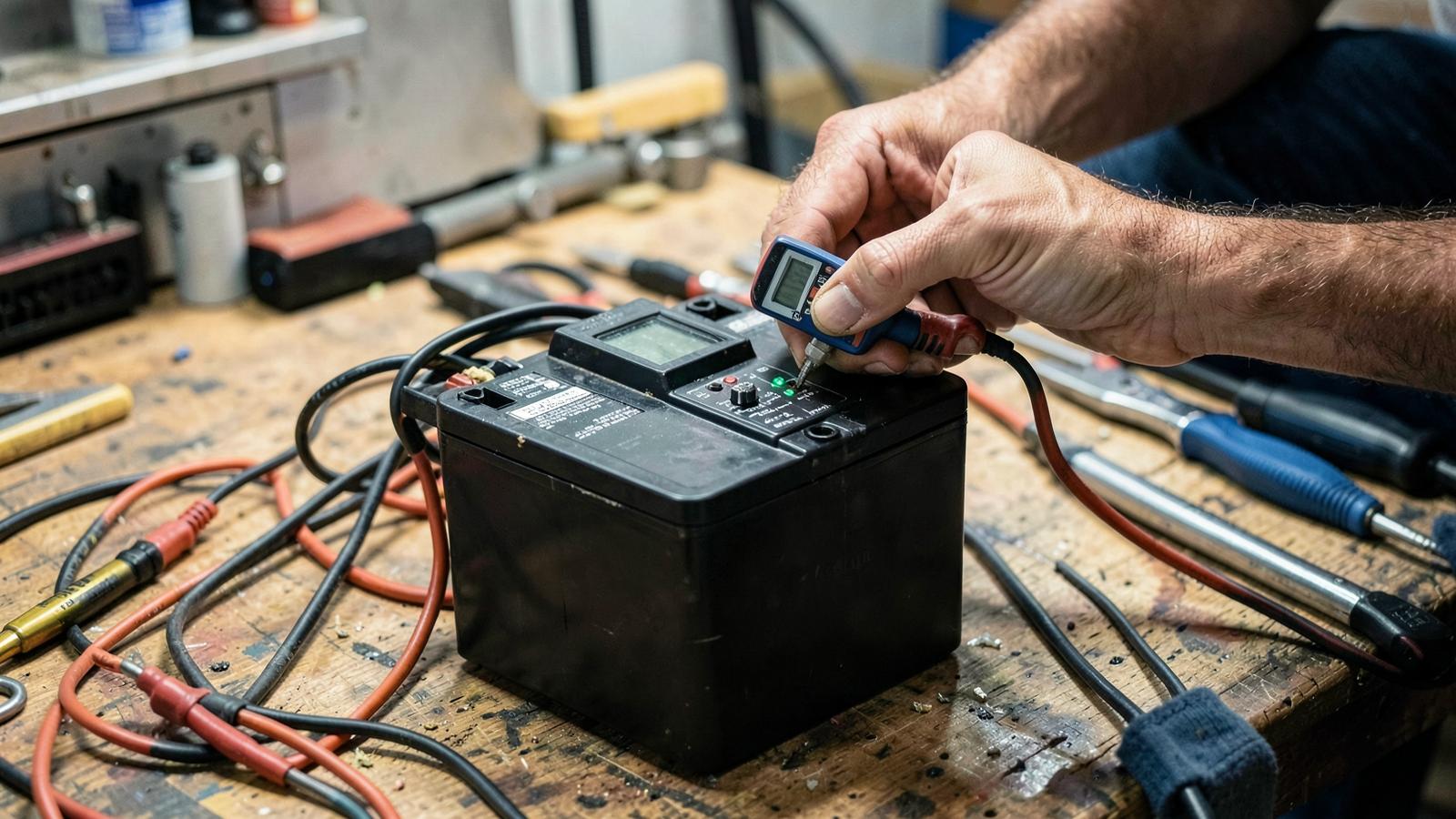
RV battery specifications use a handful of terms that determine how a battery will actually perform in your rig, and understanding them before shopping saves you from either overpaying for capacity you will not use or underbuying and running out of power mid-trip. None of the concepts here are complicated, but they are frequently glossed over in retail product listings.
This guide covers amp-hours, group sizes, depth of discharge, and charging basics in plain terms, without recommending specific products. For product picks, see our best RV batteries and best lithium RV batteries guides.
What an amp-hour rating actually means
An amp-hour (Ah) rating describes how much current a fully charged battery can theoretically deliver over one hour before it is considered discharged — a 100Ah battery could in theory supply 100 amps for one hour, or 10 amps for ten hours, though real-world discharge curves are not perfectly linear.
To estimate your daily usage, add up the amp draw of each appliance (watts divided by system voltage gives amps) multiplied by the hours you run it, and total those figures across a typical day to get your daily amp-hour consumption.
Battery group sizes and physical fit
Group sizes (such as Group 24, 27, and 31) refer to standardized physical case dimensions and terminal layouts, not to a specific chemistry or amp-hour rating. A Group 27 case is physically larger than a Group 24 and generally holds more amp-hours, but the exact rating still varies between manufacturers and chemistries even within the same group size.
Measure your existing battery compartment, including height clearance for the terminals and any hold-down hardware, before ordering a replacement, since a battery that is a fraction of an inch too tall will not fit under some compartment lids.
Depth of discharge and usable capacity
Depth of discharge (DoD) describes how much of a battery's rated capacity has been used before recharging. For AGM and other lead-acid chemistries, manufacturers commonly recommend keeping DoD to around 50% to preserve cycle life, meaning a 100Ah AGM battery effectively delivers roughly 50Ah of practical daily use. LiFePO4 batteries tolerate much deeper discharge, often to 80-100% of rated capacity, without the same degree of accelerated wear.
This is why comparing two batteries purely on their amp-hour rating, without accounting for chemistry-specific usable depth of discharge, can be misleading when estimating real-world runtime.
Charging sources and basic maintenance
RV house batteries are typically charged from one or more of three sources: the RV's converter/charger while on shore power, the vehicle's alternator while driving (via a battery isolator or DC-DC charger), and solar panels through a charge controller. Each source needs to be configured for your battery's specific chemistry — lead-acid and lithium have different optimal charging voltages and profiles.
AGM batteries require no watering or venting maintenance, but should still be checked periodically for terminal corrosion and secure mounting. Lithium batteries generally require even less routine maintenance, though periodic firmware or app updates may apply to models with smart BMS features.
Keep reading
Frequently asked questions
Final verdict
Understanding amp-hours, group sizes, depth of discharge, and charging compatibility before shopping turns RV battery buying from a guessing game into a straightforward calculation based on your actual daily power use. Once you know your target usable capacity and chemistry, our best RV batteries and best lithium RV batteries guides can help narrow down a specific model.
Editorial Team
TopPremiumPicks Editorial Team
The TopPremiumPicks Editorial Team researches and compares premium products across multiple categories using manufacturer specifications, professional reviews and customer feedback. Our guides are research-based and do not represent hands-on product testing.