
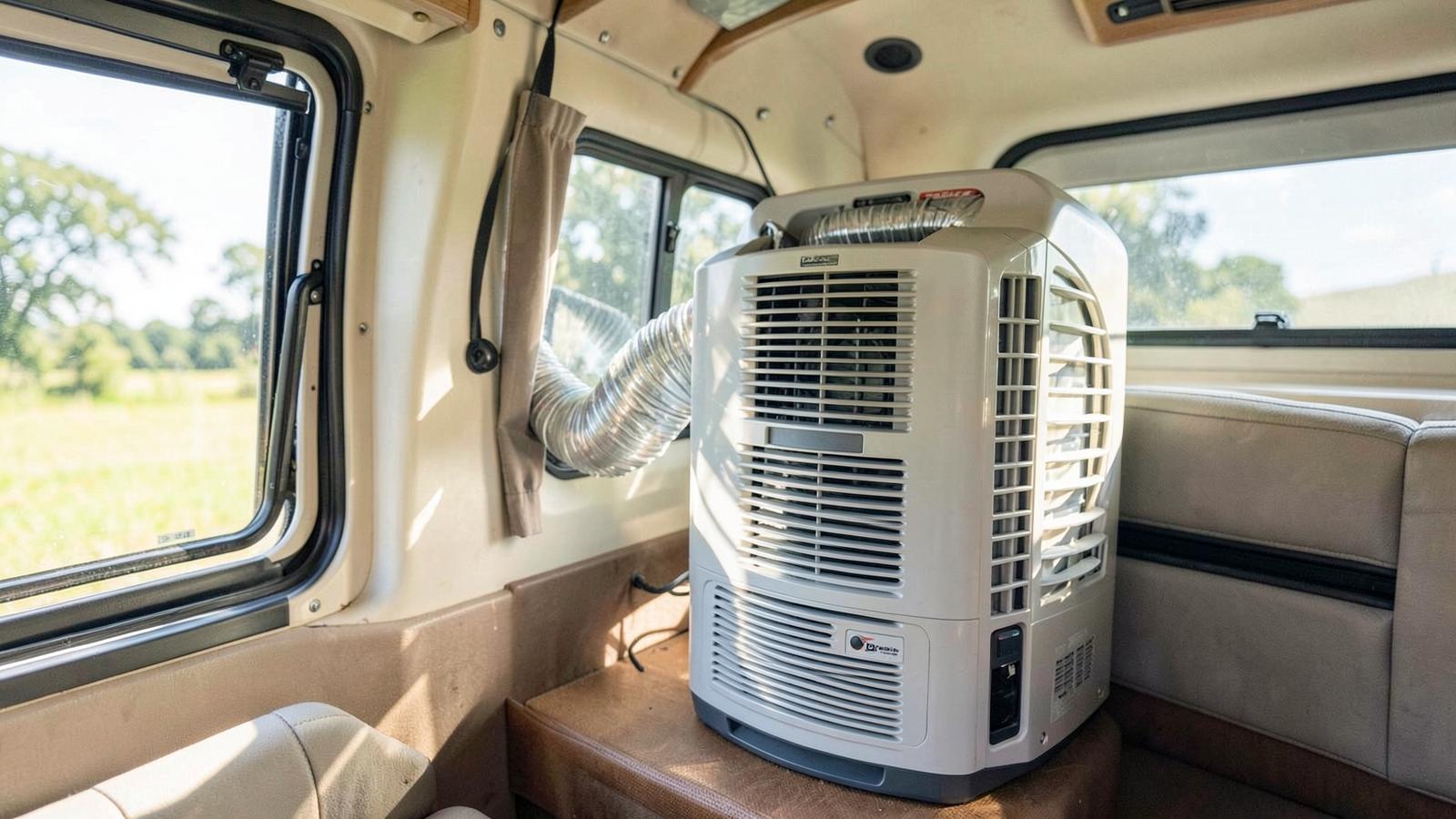
Not every camper or van has rooftop air conditioning, and even RVs that do sometimes need supplemental cooling in a bunk room or during a power outage. Portable and window-style units fill that gap without a roof cutout: most are standard home-style appliances adapted by RV owners, though a small number of products are purpose-built for van and camper use with battery power options.
The biggest practical hurdle with portable units in an RV isn't cooling capacity — it's venting and power. A single-hose portable unit needs an exhaust path to the outside, and RV windows rarely match the dimensions of the household window kits these units ship with, so some improvising with foam board or a custom-cut vent panel is common. Power draw is the other constraint: a home-style compressor unit can draw more current at startup than a 30-amp RV service comfortably supports alongside other appliances.
This guide compares the venting requirements, power draw and portability of the main options RV owners actually use, including the small number of products designed specifically to run on van or camper battery systems.
The quick answer
- Best Cooling PowerWhynter ARC-14S Dual Hose Portable Air Conditioner — Dual-hose design that cools a small RV interior far better than single-hose units.
- Best Window-MountMidea 10,000 BTU U Shaped Smart Inverter Window Air Conditioner — U-shaped inverter design that lets the window sash close over the unit.
- Best Compact PortableBlack+Decker BPACT08WT Portable Air Conditioner — Small-footprint portable floor unit with an included window venting kit.
Our top picks
Researched and compared by our editors. Prices move constantly, so check the retailer for today's price.
Affiliate disclosure — As an Amazon Associate we earn from qualifying purchases. TopPremiumPicks may also earn commissions from other retailers. This costs you nothing extra and does not influence our recommendations.
Best Cooling Power
Whynter
Whynter ARC-14S Dual Hose Portable Air Conditioner
Best for: Campers and vans without rooftop air conditioning
Key feature: Dual-hose design that pulls condenser air from outside
A dual-hose portable floor air conditioner rated at 14,000 BTU, drawing its condenser air from outside rather than from the room, which is the layout that works best in the small, poorly sealed interiors typical of RVs.
Upper Mid-Range ($$$)Best Window-Mount
Midea
Midea 10,000 BTU U Shaped Smart Inverter Window Air Conditioner
Best for: Larger campers with a compatible slide or sash window
Key feature: Variable-speed inverter compressor
A U-shaped inverter window air conditioner designed to sit around a window sash, reducing noise and allowing the window to close and lock over the unit; some camper owners adapt it for larger RV window openings.
Mid-Range ($$)Best Compact Portable
Black+Decker
Black+Decker BPACT08WT Portable Air Conditioner
Best for: Small campers and single-room supplemental cooling
Key feature: Compact portable floor design
A compact 8,000 BTU (ASHRAE) portable floor air conditioner sized for small rooms, occasionally used by owners of small campers as a low-cost supplemental cooling option.
Budget ($)| Product | Our pick | Best for | Price tier | Key feature | Check price |
|---|---|---|---|---|---|
Whynter Whynter ARC-14S Dual Hose Portable Air Conditioner | Best Cooling Power | Campers and vans without rooftop air conditioning | Upper Mid-Range ($$$) | Dual-hose design that pulls condenser air from outside | |
Midea Midea 10,000 BTU U Shaped Smart Inverter Window Air Conditioner | Best Window-Mount | Larger campers with a compatible slide or sash window | Mid-Range ($$) | Variable-speed inverter compressor | |
Black+Decker Black+Decker BPACT08WT Portable Air Conditioner | Best Compact Portable | Small campers and single-room supplemental cooling | Budget ($) | Compact portable floor design |
Price tiers $ Budget · $$ Mid-range · $$$ Upper mid-range · $$$$ Premium · $$$$$ Flagship. We show tiers rather than prices — check Amazon for the current price.
The picks in detail
Best Cooling Power
Whynter
Whynter ARC-14S Dual Hose Portable Air Conditioner
A dual-hose portable floor air conditioner rated at 14,000 BTU, drawing its condenser air from outside rather than from the room, which is the layout that works best in the small, poorly sealed interiors typical of RVs.
Why it stands out
Dual hoses avoid pulling hot outside air back into the RV, which single-hose portables do by design.
Best for
Campers and vans without rooftop air conditioning
Not ideal for
Off-grid use without shore power or a generator
Key features
- ◆Dual-hose design that pulls condenser air from outside
- ◆14,000 BTU nominal cooling capacity
- ◆Self-evaporating condensate handling in most conditions
- ◆Casters and carry handles for repositioning
- ◆Included window venting kit and washable filters
Pros
- More effective in leaky interiors than single-hose portables
- No roof cutout or permanent installation
- Can be moved between rooms or stored off-season
Considerations
- Large footprint for a small camper
- Compressor noise sits inside the living space
Final verdict
Whynter ARC-14S Dual Hose Portable Air Conditioner suits buyers who prioritise campers and vans without rooftop air conditioning. Worth knowing: Needs shore power or a sizeable generator, and takes up real floor space in a small RV.
Best Window-Mount
Midea
Midea 10,000 BTU U Shaped Smart Inverter Window Air Conditioner
A U-shaped inverter window air conditioner designed to sit around a window sash, reducing noise and allowing the window to close and lock over the unit; some camper owners adapt it for larger RV window openings.
Why it stands out
Inverter operation and U-shape design reduce noise and let the window close and lock normally.
Best for
Larger campers with a compatible slide or sash window
Not ideal for
Small camper windows that cannot accommodate the U-shaped housing
Key features
- ◆Variable-speed inverter compressor
- ◆U-shaped design allows the window sash to close and lock over the unit
- ◆SmartHome app and voice assistant control
- ◆Rated as low as 32 dBA per manufacturer listing
- ◆10,000 BTU cooling capacity
Pros
- Inverter compressor for quieter, more efficient operation
- App and remote control included
- Window remains lockable with the unit installed
Considerations
- Larger and heavier than a standard window AC
- Needs a wide enough window opening to fit
Final verdict
Midea 10,000 BTU U Shaped Smart Inverter Window Air Conditioner suits buyers who prioritise larger campers with a compatible slide or sash window. Worth knowing: Physical size and weight make it unsuitable for smaller RV window openings.
Best Compact Portable
Black+Decker
Black+Decker BPACT08WT Portable Air Conditioner
A compact 8,000 BTU (ASHRAE) portable floor air conditioner sized for small rooms, occasionally used by owners of small campers as a low-cost supplemental cooling option.
Why it stands out
Low purchase price relative to other portable options.
Best for
Small campers and single-room supplemental cooling
Not ideal for
Whole-RV cooling in warm climates
Key features
- ◆Compact portable floor design
- ◆Included window venting kit
- ◆Digital controls with remote
- ◆Built-in dehumidify and fan modes
- ◆Caster wheels for repositioning
Pros
- Affordable entry point for portable cooling
- Multiple operating modes
- Easy to relocate between rooms
Considerations
- Modest cooling capacity
- Not designed with RV windows in mind
Final verdict
Black+Decker BPACT08WT Portable Air Conditioner suits buyers who prioritise small campers and single-room supplemental cooling. Worth knowing: Window venting kit needs RV-specific adaptation and the unit takes up floor space.
Venting a portable unit in an RV
Nearly all portable floor units are single-hose designs that need the exhaust hose routed to the outside, typically through a window kit. Because these kits are built for household double-hung windows, fitting them to a sliding RV window or an awning window usually requires cutting a rigid foam or acrylic panel to match the RV's window opening and sealing around the hose.
A poorly sealed vent lets hot outside air leak back in around the hose, which reduces the unit's effective cooling and increases the load on the compressor. Spend the extra time getting a tight seal — it affects real-world performance more than any spec on the box.
Window-mounted units
A window-mounted unit sits directly in a window opening rather than needing a separate hose and kit, which some owners find simpler to fit into a slide or awning window that's roughly the right size. U-shaped inverter designs, like the Midea unit here, are quieter and let the window sash close and lock over the unit, but their larger housing needs a wider opening to fit.
Before buying a window unit for an RV, measure the actual window opening carefully — these units are designed for household window dimensions, and RV windows frequently don't match without a custom mounting bracket or infill panel.
Power draw against 30-amp service
A typical 30-amp RV electrical service has to cover the air conditioner along with the water heater, converter, and any other appliances running at the same time. Home-style portable and window units vary in startup and running amp draw, and manufacturers don't always publish this clearly for RV use cases, so checking the unit's rated running watts against your available amperage is worth doing before you buy.
Running a portable AC on the same circuit as a rooftop unit is usually not realistic on standard 30-amp service; most owners running a portable use it to supplement or replace rooftop cooling in one room rather than run both simultaneously.
Battery-powered and off-grid options
A small number of products are purpose-built for van and camper use and can run from a 12V connection or an add-on battery pack in addition to standard AC power. Availability of those models comes and goes, so check current listings before planning a build around one; standard household portable units, including the ones recommended here, need shore power or a generator.
Battery runtime and cooling capacity on these units is more limited than a plug-in compressor unit, so they suit short off-grid cooling needs — an afternoon nap or overnight in a van — better than continuous all-day cooling in hot climates.
Floor space and noise
Portable floor units take up real interior space in an RV, which is a bigger trade-off in a small camper than it would be in a house. Compact models like the Black+Decker BPACT08WT reduce the footprint somewhat but still need to sit somewhere reachable by the vent hose.
Compressor-driven portable units are generally louder than a well-maintained rooftop AC at the same distance, since the compressor sits inside the living space rather than on the roof. If noise is a concern in a sleeping area, factor this in alongside cooling capacity.
Keep reading
Frequently asked questions
Final verdict
For RVs and vans without existing rooftop AC, a dual-hose unit like the Whynter ARC-14S does the most actual cooling on shore power, while a compact portable floor unit like the Black+Decker BPACT08WT is a lower-cost option for owners who mainly need shore-power cooling. Window-mounted units like the Midea U-shaped inverter model are worth considering only if your RV's window opening is close to the unit's actual dimensions. Whatever you choose, plan the vent seal and power draw before buying rather than after.
About Our Research
TopPremiumPicks researches and compares products using manufacturer information, published specifications, reputable sources, retailer information and documented customer feedback.
How We Review Products